Enterprise AI leaders often default to a simple, highly misleading equation: more GPUs equals faster training equals faster breakthroughs to market. The reality is not so simple.
At enterprise scale, the limiting factor is less about access to compute and more how you can efficiently convert GPU-hours into usable model progress. That’s because when throughput degrades due to stragglers, synchronization stalls, or fragile recovery, time-to-market slips and TCO rises—even if capacity is available.
AI training has crossed a structural threshold where it behaves like a distributed systems problem. Coordination and operational control determine outcomes. General-purpose clouds can supply GPUs, but they weren’t designed to keep tightly coupled training workloads stable, observable, and cost-efficient at scale. If you’re seeing growing variance in performance and escalating rework, the question shouldn’t be, “How do I find more GPUs?” It should be, “Which cloud partner can help me achieve predictable throughput through observability, explainable cost through transparency, and reliable execution through a purpose-built AI cloud?”
This post breaks down five common misunderstandings about enterprise AI training that all have the potential to inflate TCO and slow delivery, and what you should prioritize instead.
Misunderstanding #1: A completed job is a successful job
Reality: The KPI isn’t “job finished.” It’s “useful work per GPU hour.”
In enterprise training, a run can finish on schedule and still deliver poor value: lower-than-expected model quality, non-reproducible results, or checkpoints you can’t reliably restart from. At distributed scale, this turns GPU spend into time-to-market risk and makes TCO unpredictable.
The most damaging issues rarely announce themselves. A degraded node, intermittent I/O stalls, or a subtle synchronization problem can quietly erode throughput or corrupt intermediate state. By the time the board asks why costs climbed without much to show for it, enterprise teams relying on general-purpose cloud have already sunk weeks or months into wasted GPU-hours and lost iteration cycles. The organizations that scale confidently are the ones that can see these breakdowns early and proactively correct them before they compound.
What to look for: Infrastructure tooling that surfaces workload health by design, exposing the signals that actually reflect how the training performed, not just that it ran its course.
Misunderstanding #2: Training speed equals training efficiency
Reality: Speed wins demos, efficiency wins quarters.
Enterprise teams often benchmark AI infrastructure on pace: how quickly GPUs come online, how much capacity is available, and how fast jobs enter and exit the queue. But speed is only valuable when it translates into measurable model progress. If orchestration delays, idle time, or data-path bottlenecks are invisible, it can look like you’re moving fast while actually standing still, spending premium GPU hours that are stuck in idle for marginal gains.
That’s why Model FLOPs Utilization (MFU) is a more executive-relevant metric than raw spin-up time or headline throughput. MFU captures how much of the compute you allocate actually advances training versus being lost to overhead, coordination, and waiting. Most organizations discover that a meaningful share of their spend is leaking through this gap, and the invoice won’t tell you where. Improving MFU even a few points is one of the cleanest ways to increase output without increasing the line items on your bill.
What to look for: Purpose-built infrastructure that makes efficiency visible without requiring teams to instrument it separately.
Misunderstanding #3: General-purpose infrastructure behaves the same at scale
Reality: Bottlenecks have their own scaling laws.
If scaling training were merely a capacity question, the solution would be simple: procure more GPUs and compress timelines. But at enterprise scale, the constraint shifts from supply to coordination. Each additional node expands the system you have to synchronize, observe, and recover, and general-purpose infrastructure typically loses efficiency long before you run out of raw compute. The result is what every executive dreads: bigger clusters, higher spend, and less predictable progress.
The failure modes are consistent and financially material. One underperforming node can slow an entire distributed job; a small disruption can trigger retries and scheduling churn that leave expensive capacity idle; and minor variance in network or data paths can compound into weeks of throughput erosion across a program. As scale increases, these issues stop being edge cases and start behaving like operating conditions. That’s why “works in a pilot” is a far cry from “works in full-scale production.”
What to look for: Infrastructure-enforced execution discipline across nodes and racks so that coordination demands don't compound into performance collapse.
Misunderstanding #4: The line item is GPUs
Reality: Cost overruns come from everything else.
AI training budgets have a habit of drifting from plan—10x the workload does not equate cleanly to 10x the compute cost. Cost inflation typically originates from the way workloads behave at scale, not from a single line item, and without clear visibility and control over how workloads operate in production-scale environments, you might find an unpleasant surprise on your invoice.
So what’s driving up costs? Repeated retries that quietly consume GPU hours, cold data continuing to generate ongoing movement and retrieval costs, and hidden egress charges that arrive after the fact with little context. Over time, spending rises faster than the models progress, AI leaders lose clear visibility into why, and the conversation shifts from “how fast can we train” to “how do we justify this to the CFO.”
What to look for: Costs aligned to how AI workloads actually operate, as opposed to flat rates that penalize access patterns that teams can't predict.
Misunderstanding #5: Support is less important than raw compute power
Reality: At AI-scale, expertise isn't a support tier—it's infrastructure.
When large-scale training breaks, the culprit is rarely lack of capacity—it’s wasted time. Minutes of degraded throughput and hours of stalled capacity translate directly into delayed launches, missed business milestones, and rising cost per trained model. In that environment, support is not a service add-on. It is a core control mechanism that protects time-to-market and helps keep TCO predictable by minimizing both downtime and rework.
Standard cloud support models are built to address incidents, not to quickly restore production-grade training performance. Escalation paths optimized for ticket volume and generic runbooks struggle with the reality of distributed training, where root cause may sit in fabric behavior, synchronization pathologies, or data throughput collapse that only appears under full load. Access to AI experts can mean the difference between a manageable disruption and a multi-day setback. For executives, the practical takeaway is simple: the right AI cloud partner reduces risk through faster resolution and sustained efficiency, not just more compute.
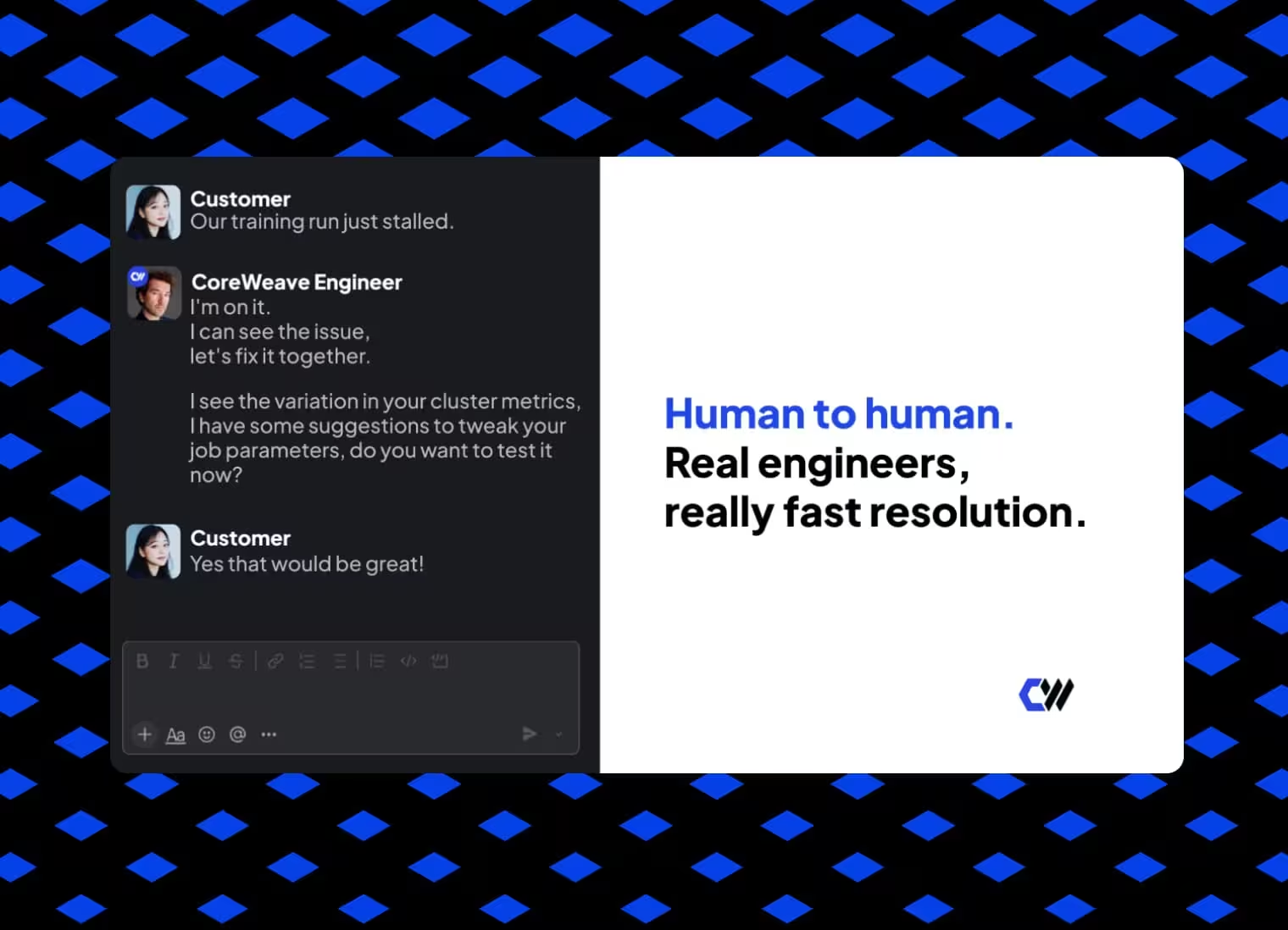
What to look for: Direct access to engineers who understand your workloads at the hardware and software level—not queues or a ticketing system.
What next?
Want to learn more about how a purpose-built AI cloud’s TCO compares to running AI workloads on general-purpose cloud infrastructure? Check out Signal65’s comprehensive TCO analysis of AI cloud deployments.
Want to see how CoreWeave competes against hyperscalers and neoclouds? Learn how we earned the only Platinum rating in SemiAnalysis’s ClusterMAX™ AI cloud rating system—and did it twice.