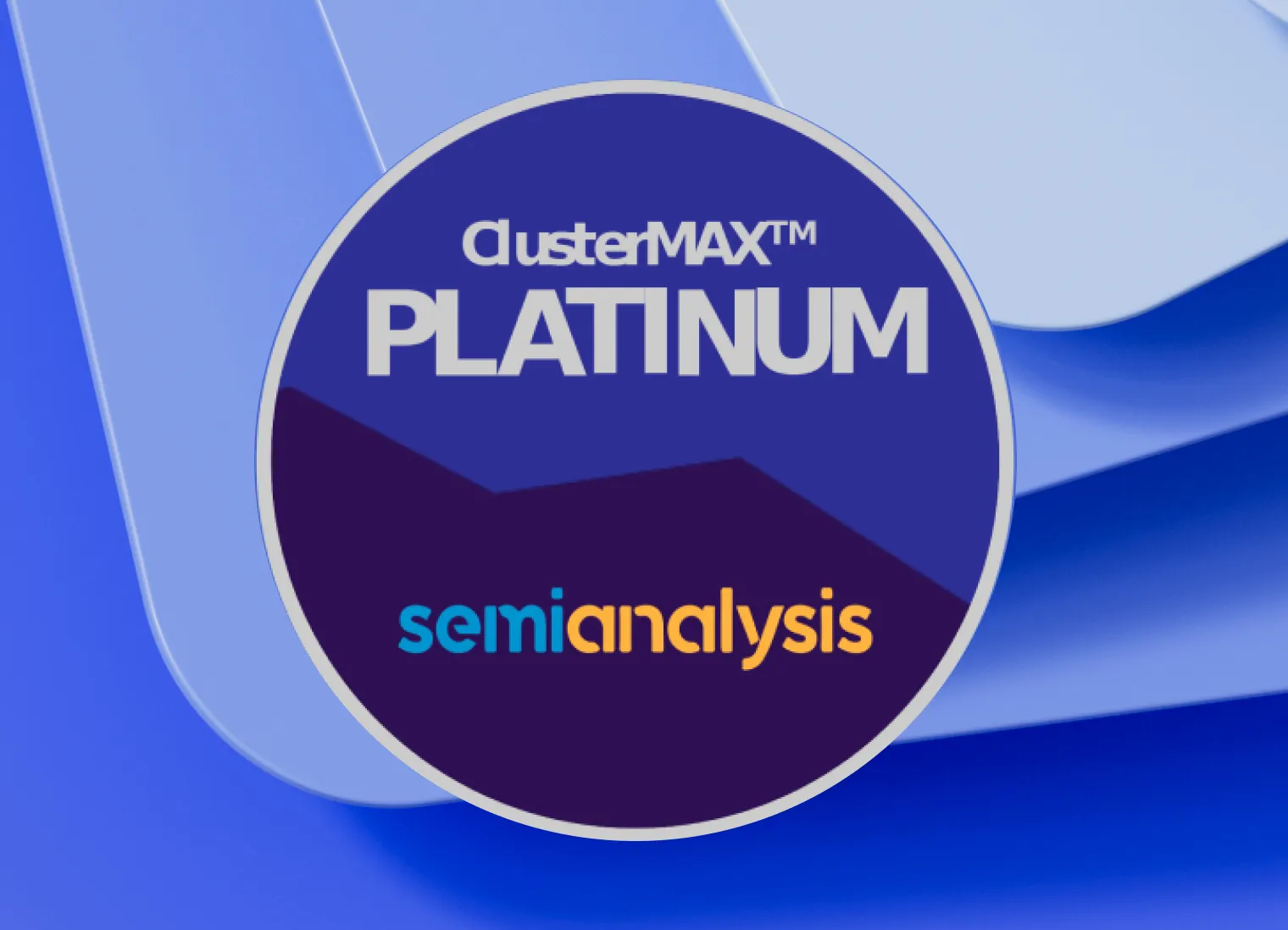
As we head into the holiday season, we wanted to close out the year with a deep dive into the Semianalysis ClusterMAX 2.0 report. But first, we want to extend our sincere thanks to our customers, partners, and team for an incredible 2025. We look forward to an even brighter 2026—the future is bright because of all of you.
We view reports like ClusterMAX™ as live audits of our engineering judgment and how our principles hold up under pressure. Ratings are the outcome, not the goal. The real goal is predictable progress for our customers, delivering performance, reliability, and scale that they can depend on.
This post is about that mindset: what the results actually mean, why design choices shape outcomes at scale, and how we’re preparing for the next order-of-magnitude leap in AI infrastructure.
Why a second rating so soon matters
SemiAnalysis released its latest ratings within months of their first report. The jump from 26 to 84 providers is a clear indication of how rapidly the AI market is evolving.
The technology landscape that supports it is evolving just as quickly, with greater demands on every new generation of hardware and software. As expectations for reliability and overall workload experience rise, the interdependence between data and compute is becoming even more pronounced. For customers, this means platforms must evolve seamlessly across generations—scaling performance, capacity, and capability without disruption.
We believe anticipating and not reacting to constant advancements is the hallmark of modern AI infrastructure. That belief drives how we build at CoreWeave.
Building with purpose— engineering that delivers customer impact
CoreWeave sets the bar for others to follow and is the only cloud to consistently command premium pricing in interviews with end users.
— SemiAnalysis ClusterMAX™ 2.0 report
Reliability is the first principle of AI infrastructure. Whether it’s training a frontier model, serving millions of inference requests, or powering mission-critical workloads, systems must perform consistently and without surprises. In training, a single interruption can reset days of progress. Inference systems drive healthcare tools, financial models, and customer applications that depend on consistent responses, not surprises. Video and multimodal generation pipelines require tight coordination across GPUs, where even brief instability shows up as visible artifacts or dropped frames. For enterprise AI, reliability is closely tied to security and isolation; the platform must perform predictably for every tenant and every workload. Across all of these, reliability isn’t a feature — it’s the foundation that lets customers build with confidence.
Delivering that level of reliability requires a radically different approach to deploying hardware. We build in checkpoints at every level to manage failures and mitigate customer impact.
Drives double-digit improvements in utilization and removes the hand-off friction between research, training, and production.
Our SUNK (Slurm-on-Kubernetes) framework offers deep integration with CoreWeave Mission Control, enabling the handling of queues with over 100,000 jobs. By utilizing a robust priority system, the platform ensures massive pretraining workloads run uninterrupted, while a backlog of preemptible research sweeps automatically backfills any spare capacity.
Consistent 99% rack-level uptime and training campaigns that finish on time
Modern GB200 NVL72 systems shift the failure domain from a single node to the entire rack. We designed a custom Rack LifeCycle Controller that acts as the controller of controllers, managing GB200 and GB300 NVL72 systems as unified objects. Our ability to employ a correlation engine during sustained multi-node burn-ins, detect faults, quarantine them, and reprovision healthy nodes on the spot has helped us lead the way in large-scale Grace Blackwell deployments. What used to mean multi-day outages are now identified and resolved in minutes.
Bare-metal performance with the predictability of a fully segmented environment
Noisy neighbors are the enemy of deterministic performance. Every CoreWeave node features an NVIDIA BlueField DPU that offloads network, storage, and security functions from the host CPU, ensuring each customer’s workloads are fully isolated and protected without compromising speed. This bare-metal, zero-trust design is purpose-built for AI workloads, delivering consistent low-latency performance even under the heaviest training and inference demand.
End-to-end monitoring and predictive health
Traditional health checks tell you when something has already failed. We combine NVIDIA Data Center GPU Manager (DCGM) metrics, NVIDIA Management Library (NVML) sensors, and interconnect telemetry to flag anomalies before they impact a job. For customers, this means fewer restarts, faster recovery, and the ability to diagnose issues in minutes, rather than waiting for ticket cycles to resolve.
Significantly reduced load times by keeping data close to the compute
Training on petascale datasets demands more than fast storage. It demands proximity.
Our CoreWeave AI Object Storage and LOTA (Local Object Transport Accelerator) caching layer automatically stages active data onto local NVMe drives, sustaining multi-GB/s per-GPU throughput.
Secure by design
Security should enable, not constrain, experimentation. Our zero-trust architecture begins at boot with SPDM (Security Protocol and Data Model) firmware attestation and extends through Chainguard base images and isolated BMC (baseboard management controller) networks. Compliance standards, such as SOC 2 and ISO 27001, are built in from the ground up, allowing regulated customers to deploy without additional hardening or audit overhead.
Direct-to-expert support
Our support engineers are the same people who build and operate our infrastructure. This direct-to-expert model maintains tight feedback loops, ensuring that insights from real workloads are integrated directly into product design. For customers, it means faster resolution, fewer escalations, and the confidence that the people behind the platform are as invested in their success as they are.
Pace, performance, and partnership: The bar keeps moving
Everything about CoreWeave’s architecture is optimized for momentum—built for demand where clusters scale to tens of thousands of GPUs in minutes, workloads launch in seconds, and data flows at full bandwidth without compromise. That pace translates directly into performance. And we don’t stop at infrastructure; our engineers work alongside customers, sharing telemetry, tuning pipelines, and solving edge cases together. The result is not just speed, but trust—a partnership that compounds over time.
Competition is heating up. And that’s good news because every leap in this space lifts the entire ecosystem. And in the end, the real winner isn’t any single provider. It’s the customers who gain better performance and a faster path to execution. When we get this right, your teams think less about infrastructure and more about ideas. And that’s the whole point.
- Read the full ClusterMax 2.0 report from SemiAnalysis to see how CoreWeave stacks up (and over) every other AI cloud.
- Learn more about what makes CoreWeave Cloud unique and why we’re the leader in the AI cloud category.
- Download the AI Cloud whitepaper to read why CoreWeave Cloud is the force multiplier for AI innovation.
- Explore how industry-leading AI labs and global enterprises alike are leveraging CoreWeave to accelerate breakthroughs and shape the future of AI.