

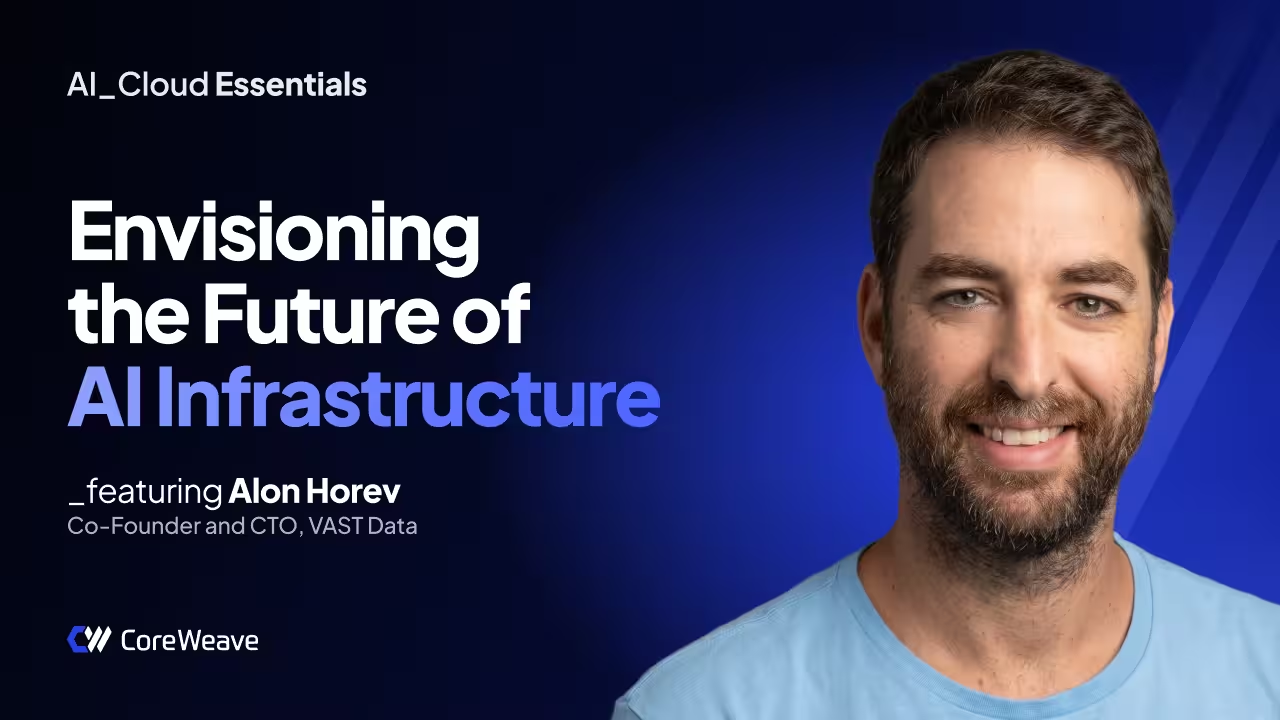

Episode 21: AI Cloud Essentials Podcast
As AI workloads grow in scale and complexity, traditional data infrastructure is struggling to keep pace. Organizations need more than powerful GPUs—they need high-performance storage, real-time data access, and scalable infrastructure designed to support modern AI training, inference, and agentic applications.
In this episode of AI Cloud Essentials, host Ritu Jyoti sits down with Alon Horev, Co-Founder and CEO of VAST Data, to explore how VAST Data and CoreWeave are working together to rethink the data layer for AI. Learn how their partnership brings together AI-native cloud infrastructure and advanced data capabilities to help organizations improve efficiency, optimize costs, and scale increasingly demanding workloads.
The conversation explores why traditional storage architectures are being challenged by massive GPU clusters, how multi-tenancy and flexible consumption models can improve infrastructure utilization, and why real-time data streaming is becoming essential for the next generation of agentic AI applications.
What you’ll learn
- Why AI workloads require a new approach to data infrastructure
- How VAST Data and CoreWeave are co-engineering infrastructure for AI
- How high-performance storage and data access support large-scale GPU workloads
- Why efficiency, multi-tenancy, and flexible consumption models matter for AI infrastructure
- How data requirements differ across training, inference, and reinforcement learning
- Why real-time data streaming is becoming critical for agentic AI
Guest: Alon Horev, Co-Founder and CEO of VAST Data
1
00:00:00,040 --> 00:00:06,600
We are rapidly seeing growth of AI adoption and AI workflows that require performance, data
2
00:00:06,640 --> 00:00:13,000
streaming, and vast scale of data. VAST is building an AI operating system, basically serving the
3
00:00:13,000 --> 00:00:19,160
infrastructure software infrastructure that's needed to build AI applications. Partnerships are
4
00:00:19,200 --> 00:00:24,400
a blessing, as well as a little bit of a challenge to kind of navigate. When we met CoreWeave for the
5
00:00:24,400 --> 00:00:30,320
first time, both companies were much smaller. We basically came together and envisioned what would
6
00:00:30,320 --> 00:00:36,120
be the best, you know, infrastructure for AI that we could innovate and co engineer together. In the
7
00:00:36,120 --> 00:00:43,040
age of deployment of so much power and compute and data, we have no excuse for
8
00:00:43,040 --> 00:00:48,440
not being efficient. We're 1300 people pretty much spread across the globe. And I get to work with
9
00:00:48,440 --> 00:00:52,120
the likes of CoreWeave on building the future of AI infrastructure.
10
00:01:03,760 --> 00:01:09,720
So in today's hyper-connected tech landscape, no single platform can power the entire AI stack
11
00:01:09,720 --> 00:01:16,280
alone. Agentic AI workflows that require high performance, real-time data streaming, and vast
12
00:01:16,280 --> 00:01:22,280
amount of data at scale. So I'm super excited about talking about the unique partnership
13
00:01:22,280 --> 00:01:29,200
between CoreWeave and VAST Data. And I'm joined by Alon from Vast Data today. Welcome, Alon. Thank
14
00:01:29,200 --> 00:01:35,320
you. Happy to be here. Awesome. Could you please introduce yourself and VAST Data to the audience?
15
00:01:36,160 --> 00:01:43,080
Sure. Uh, nice to meet you. I'm Alon Horev, co-founder and CEO at VAST Data. VAST is building an
16
00:01:43,080 --> 00:01:48,280
AI operating system. Basically serving the infrastructure software infrastructure that's
17
00:01:48,280 --> 00:01:54,600
needed to build AI applications. We're mostly known for storage, which is what we started with.
18
00:01:54,600 --> 00:02:00,680
So we deliver storage services, storage software that's powering a lot of the model
19
00:02:00,680 --> 00:02:05,480
training and inference that's happening out there today. We are 1300 people pretty much spread
20
00:02:05,480 --> 00:02:11,800
across the globe, and I get to work with the likes of CoreWeave on building the future of
21
00:02:11,800 --> 00:02:18,160
AI infrastructure. That's exciting. So let's start the discussion. I'm sure our audience is going to
22
00:02:18,160 --> 00:02:24,400
love it. My first question to you is what was the business driver or the essential business
23
00:02:24,400 --> 00:02:30,240
requirement that brought this partnership together? So I think, you know, when we met CoreWeave for
24
00:02:30,240 --> 00:02:35,839
the first time, both companies were much smaller. We were about 30 people back then.
25
00:02:35,840 --> 00:02:42,720
But it was clear that the massive need for AI infrastructure
26
00:02:42,720 --> 00:02:48,919
is arising, right? And with that need for compute and networking, there's also a need for
27
00:02:48,920 --> 00:02:55,760
having fast access to data. And we basically came together and envisioned what
28
00:02:55,760 --> 00:03:00,840
would be the best infrastructure for AI that we could co innovate and co-engineer
29
00:03:00,840 --> 00:03:05,749
together. The folks at CoreWeave had lots of experience building and deploying systems,
30
00:03:05,750 --> 00:03:11,869
including storage in their past. So they already were able to reflect to us requirements and
31
00:03:11,869 --> 00:03:16,070
things that they felt would be innovative, but also appreciate some of the things that we've
32
00:03:16,070 --> 00:03:22,149
already done. And that's how we started. We knew that we wanted to apply first-principle thinking
33
00:03:22,149 --> 00:03:27,350
and build something that's truly innovative, that can beat other solutions at every metric, from
34
00:03:27,350 --> 00:03:33,509
latency to throughput to scalability. But also solve for some some unsolved problems like
35
00:03:34,229 --> 00:03:39,709
how do we reimagine multi-tenancy and isolation in the new world of infrastructure, doing bare
36
00:03:39,710 --> 00:03:45,229
metal hosting? So we had a bunch of ideas that each one of us brought together as we kicked off
37
00:03:45,230 --> 00:03:51,949
this partnership. Yeah, that's great to hear because in the era of AI, it is
38
00:03:51,950 --> 00:03:58,149
so data-hungry, and making sure that data is rightly governed and rightly served
39
00:03:58,149 --> 00:04:03,749
across different environments is so, so fundamental. So before we go further along, I was
40
00:04:03,749 --> 00:04:10,710
wondering, you know, partnerships are a blessing as well as a little bit of a
41
00:04:10,710 --> 00:04:16,230
challenge to kind of navigate. So my question to you is that in order to bring in operational
42
00:04:16,230 --> 00:04:22,989
fusion, how did you all integrate for velocity? Meaning how did you align the cultures, code bases
43
00:04:23,029 --> 00:04:29,069
and stats to remove friction for the end-user? That's a great question. You know, the way I
44
00:04:29,070 --> 00:04:34,750
look at partnerships is that they have to be strategic. They need to make sense now,
45
00:04:34,750 --> 00:04:39,389
but they also need to make sense in a year from now and into the future. And that requires
46
00:04:39,390 --> 00:04:46,309
alignment in various ways. First of all, it needs to be an alignment of DNA. How do the
47
00:04:46,309 --> 00:04:52,630
organizations operate? How do they innovate? How do they engineer? And we have our engineering team
48
00:04:52,869 --> 00:04:57,509
working very closely with the CoreWeave engineering team, where we really architect
49
00:04:57,510 --> 00:05:02,669
solutions together, right? And then we execute upon them and we measure ourselves upon them. And it
50
00:05:02,670 --> 00:05:08,029
starts with DNA, but it continues into an operational mindset of how do we deliver working
51
00:05:08,030 --> 00:05:14,469
solutions to our joint customers, and really being able to operate as an extension of CoreWeave's
52
00:05:14,469 --> 00:05:20,189
engineering power, right? CoreWeave would not have selected us if we weren't able to run at
53
00:05:20,190 --> 00:05:26,910
the pace that CoreWeave is running on its own and being able to only amplify CoreWeave's
54
00:05:26,760 --> 00:05:31,719
velocity and not pull it back. So I think it starts with the DNA and it continues
55
00:05:32,309 --> 00:05:38,229
with both an operational mindset, but also a good execution plan and an interlock between the
56
00:05:38,230 --> 00:05:44,350
engineering team. So do you have executive sponsorship, regular cadence of interactions and
57
00:05:44,350 --> 00:05:50,790
mitigating all the issues that came along? We do. We have a lot of that. But I would also
58
00:05:50,790 --> 00:05:57,589
say that we have alignment at various levels of the organizations that you actually don't need
59
00:05:57,589 --> 00:06:03,429
to have an escalation to a high top executive to get something resolved. This is where
60
00:06:03,429 --> 00:06:09,150
alignment happens, where we know how the infrastructure behaves together with CoreWeave.
61
00:06:09,310 --> 00:06:13,429
And we want to be proactive and we want to be understand how things are behaving and whether
62
00:06:13,429 --> 00:06:18,590
customers are happy, even without asking them or hearing them complain, even before something like
63
00:06:18,590 --> 00:06:24,469
that happens. Both organizations are very proactive in monitoring and engaging, and the same
64
00:06:24,469 --> 00:06:28,669
also applies to how we come up with new solutions to interesting challenges and come up with
65
00:06:28,670 --> 00:06:34,989
innovation. And I think that's part of the recipe for a good partnership. Did you ever run
66
00:06:34,989 --> 00:06:41,950
into some kind of code-stack discrepancies, or any kind of software mismatch that you had
67
00:06:41,950 --> 00:06:48,070
to kind of navigate? I think with any integration there are obstacles, right? And this is where being
68
00:06:48,070 --> 00:06:54,349
able to collaborate very deeply and move fast together towards the same goal, which is
69
00:06:54,350 --> 00:06:58,790
how do we build the best AI infrastructure that we can humanly
70
00:06:58,829 --> 00:07:03,029
imagine? It's understandable that we're going to bump into challenges, but it's also the
71
00:07:03,029 --> 00:07:07,150
opportunity because when we're building together, we have an opportunity to build something that's
72
00:07:07,150 --> 00:07:13,020
extremely differentiated for both sides. So I think I think challenges are good. And you meet
73
00:07:13,020 --> 00:07:18,499
them along the way. And as you integrate, you design and you finalize APIs for how data path
74
00:07:18,499 --> 00:07:24,099
and control plane and monitoring and know how all of those things work. But they eventually
75
00:07:24,099 --> 00:07:29,179
contribute, for example, to CoreWeave's user experience to get a single pane of glass that has all the
76
00:07:29,180 --> 00:07:35,139
information that the user needs to understand how the infrastructure is behaving. Got it. Got it. So
77
00:07:35,380 --> 00:07:41,179
my next question is that, as we all know, this is all being done for the interest and
78
00:07:41,180 --> 00:07:47,419
the common benefit of the end user. Right. So could you talk to me about how did the two
79
00:07:47,420 --> 00:07:53,059
technologies and this partnership create compounding value for the end-user? I think
80
00:07:53,059 --> 00:07:57,499
there are several angles here that I would say the first one is really about
81
00:07:57,899 --> 00:08:04,259
efficiency in the age of deployment of so much power and compute and data
82
00:08:04,660 --> 00:08:10,059
we have no excuse for not being efficient. We really need to be efficient in how we use
83
00:08:10,059 --> 00:08:14,859
hardware and how we use the power, because that translates to billions of dollars of savings. And
84
00:08:14,859 --> 00:08:19,858
this is why VAST has invested years and years into algorithms and data structures that allow us to
85
00:08:19,859 --> 00:08:26,780
compress data and allow us to use and leverage a very dense QLC Flash. These technologies did
86
00:08:26,780 --> 00:08:33,019
not exist before we started working on them, and I think that attributes to efficiency.
87
00:08:33,260 --> 00:08:40,259
Then there's scalability, because the workloads that we're seeing today are unprecedented in terms
88
00:08:40,259 --> 00:08:47,179
of their scale. You can see one job running on top of 200,000 GPUs, right? Imagine one process that's
89
00:08:47,179 --> 00:08:53,780
so distributed that it needs to run on so many machines at the same time and access vast amounts
90
00:08:53,780 --> 00:08:58,418
of information, hundreds of petabytes at a time. The innovation and engineering work that was
91
00:08:58,419 --> 00:09:02,378
required to to enable that has been massive, and that's what we've been working on for
92
00:09:02,379 --> 00:09:08,899
ten years. So I think these are new challenges that came because of of new AI
93
00:09:08,939 --> 00:09:13,979
workloads. This is how large scale training looks like. And inference is also disaggregated these
94
00:09:13,979 --> 00:09:20,019
days and scales across machines. And these are the things that we are delivering together that are
95
00:09:20,020 --> 00:09:26,299
very different in terms of how infrastructure was built in a general-purpose cloud or in a
96
00:09:26,300 --> 00:09:32,819
more legacy type environments that were focused on general purpose CPU workloads. Yeah. I think you
97
00:09:32,820 --> 00:09:37,460
very well said that, you know, it was primarily about efficiency. And, you know, as we know, because
98
00:09:37,460 --> 00:09:44,060
in the era of AI, cost has been a big inhibitor and people are struggling to realize ROI.
99
00:09:44,099 --> 00:09:49,379
So any sort of efficiency in terms of seamless experience, it would have definitely equated to
100
00:09:49,419 --> 00:09:55,699
some cost reduction, time to value, time to insight. Is there any specific metric beyond efficiency
101
00:09:55,700 --> 00:10:00,659
that comes to your mind, or do they all kind of correlate? So there are additional metrics.
102
00:10:00,659 --> 00:10:05,539
And I think one of them is not necessarily a metric but a trait. Fungibility. And fungibility is
103
00:10:05,539 --> 00:10:11,380
a very big deal in the cloud because it allows creating alignment between how customers want to
104
00:10:11,460 --> 00:10:18,179
consume and how cloud service providers sell. Customers want to pay on what they're using, right?
105
00:10:18,340 --> 00:10:23,579
The notion of spot instances or allocating and provisioning and releasing things like virtual
106
00:10:23,580 --> 00:10:29,699
machines or GPUs or even storage is one of the things that the big clouds have really
107
00:10:29,699 --> 00:10:35,859
innovated with. And now we see the same challenge and opportunity in this space that we're
108
00:10:35,859 --> 00:10:41,579
working on right now, which are clouds for AI. So the opportunity for CoreWeave, by
109
00:10:41,659 --> 00:10:47,178
deploying multi-tenant environments, is for those customers that need more flexibility and more
110
00:10:47,179 --> 00:10:54,139
flexible consumption models and also utilization models. That's a big opportunity, right? So CoreWeave
111
00:10:54,140 --> 00:10:59,339
has to solve this for the networking, to provide strong isolation. They need to provide that kind
112
00:10:59,340 --> 00:11:04,099
of multi-tenant experience to the GPU nodes. And we're doing that for the data side as well. So
113
00:11:04,099 --> 00:11:09,620
being able to provision capacity and provision performance unlocks flexibility and fungibility
114
00:11:09,659 --> 00:11:16,009
for the end customers. That's extremely important. And you will still have large
115
00:11:16,010 --> 00:11:21,809
customers, frontier labs, large enterprises that are going to be able to make large
116
00:11:21,810 --> 00:11:26,049
commitments in advance. But so many of the customers out there want to have the flexibility
117
00:11:26,049 --> 00:11:30,729
to not pay for everything in advance. And there's a big win-win situation for all three parties
118
00:11:30,729 --> 00:11:36,289
involved by enabling that kind of efficiency model. Great. Is there a
119
00:11:36,289 --> 00:11:42,928
specific industry or geography where you're seeing more traction versus the other?
120
00:11:43,329 --> 00:11:48,769
You know, so VAST started before AI was a big deal, right? We started the same month when OpenAI
121
00:11:48,769 --> 00:11:55,129
was incorporated. And we were initially focusing on high-performance computing and analytics on
122
00:11:55,130 --> 00:12:01,249
large enterprises, internet companies, because we knew that lots of data in one place with fast
123
00:12:01,249 --> 00:12:07,449
access has lots of value for big data analytics. Now, it's also very obvious that for AI, it's
124
00:12:07,450 --> 00:12:12,889
even more intense and it gets even bigger. So obviously AI is growing at an exponential pace,
125
00:12:12,890 --> 00:12:18,928
and we see that through our customers that grow with us and adopt the platform. But we also
126
00:12:18,929 --> 00:12:24,689
continue to see other sides of the market continuing to evolve and then apply the same
127
00:12:24,690 --> 00:12:30,689
principles of AI. Customers like, you know, CC Bio. The Chan Zuckerberg Foundation was a customer of
128
00:12:30,689 --> 00:12:35,409
ours, but also operates inside of CoreWeave. The same principles of going from classic machine
129
00:12:35,409 --> 00:12:42,329
learning to adopting AI and leveraging neural nets, leveraging LLMs to tackle other segments and
130
00:12:42,330 --> 00:12:47,968
other challenges in the market, beyond just classic text generation, is what we're now
131
00:12:47,969 --> 00:12:54,009
seeing with our customers in the farming industry, healthcare, autonomous driving, animation, so many
132
00:12:54,010 --> 00:13:00,010
different and fascinating initiatives, that we see classic machine learning and classic methods
133
00:13:00,210 --> 00:13:05,929
completely transformed and reimagined through this lens of AI. So we are seeing a big investment
134
00:13:05,929 --> 00:13:12,209
into AI, but not just through the frontier labs and the infrastructure providers. We also see that
135
00:13:12,210 --> 00:13:18,608
through the end customers that are investing deeply in individual initiatives. Great. So,
136
00:13:19,169 --> 00:13:25,969
this is a fascinating set of insights. And I'd like to kind of close the discussion because we
137
00:13:25,969 --> 00:13:31,169
want to know that you have learned a lot of lessons partnering with CoreWeave in
138
00:13:31,169 --> 00:13:38,090
the last couple of months, years. What is the journey forward? What does
139
00:13:38,090 --> 00:13:44,168
the future vision look like? What did you learn based on your best practices? What is your
140
00:13:44,210 --> 00:13:49,489
kind of call to action to anybody who's listening to us? Or where do you see the journey going ahead?
141
00:13:49,530 --> 00:13:56,048
So that's obviously my perspective. But I see two vectors. I think one of them is scaling.
142
00:13:56,049 --> 00:14:01,809
Every time you increase, you know, the size of a company or the size of an operation, you need
143
00:14:01,810 --> 00:14:08,010
to optimize, and you need to reimagine how it is that you architect this entire process. So this
144
00:14:08,010 --> 00:14:14,449
vector of growth for CoreWeave seems to be massive. And, you know, the revenue backlog speaks for itself.
145
00:14:14,450 --> 00:14:19,280
But at the same time, there is an opportunity to serve more and deliver more value to those end
146
00:14:19,280 --> 00:14:26,239
customers instead of just, you know, leasing out raw GPUs. A lot of those customers are trying
147
00:14:26,240 --> 00:14:30,639
to solve similar problems. There is an opportunity to deliver more value to them, to give them more
148
00:14:30,640 --> 00:14:36,399
managed services, to take more off their plate in terms of deploying inference, deploying frameworks
149
00:14:36,400 --> 00:14:41,999
they would use for training, fine tuning, reinforcement learning. CoreWeave is becoming an
150
00:14:41,999 --> 00:14:48,598
expert, and IS an expert, in all of those other aspects of of the AI development lifecycle. And
151
00:14:48,599 --> 00:14:55,159
the way we approach it is that data comes in different shapes and forms, right? We started with
152
00:14:55,160 --> 00:15:00,879
training and we stored checkpoints and data sets and home directories. But now when you look at
153
00:15:00,879 --> 00:15:04,639
inference, there are so many different other modalities of data. You store vectors to do
154
00:15:04,680 --> 00:15:10,079
similarity search. You store events for event streaming, because all of your users or
155
00:15:10,120 --> 00:15:16,200
agents are generating so much data. You start to accelerate how inference is running today. So we
156
00:15:16,280 --> 00:15:22,439
have those joint opportunities in delivering more value, delivering higher-order services that would
157
00:15:22,439 --> 00:15:26,880
enable CoreWeave to deliver more value to its customers, to increase its margins, and to be
158
00:15:26,880 --> 00:15:31,560
differentiated in the market. And this is a principle that also applies to us. The same
159
00:15:31,560 --> 00:15:36,919
platform, the same software running on the same flash can support more modalities of data. So we
160
00:15:36,919 --> 00:15:42,359
started with file, but now it's also object and block and event streaming at a database. And we
161
00:15:42,359 --> 00:15:49,039
are very aligned with CoreWeave, just providing more value to our customers over time. Great. Thank
162
00:15:49,040 --> 00:15:55,999
you Alon. This is fantastic. And I cannot agree more that, you know, in the era of agenetic AI, real
163
00:15:56,039 --> 00:16:01,879
time data availability, context retrieval, and all different types of data ingestion is very, very
164
00:16:01,879 --> 00:16:07,559
critical to autonomous agent architecture. This is going to be fascinating journey for the two of
165
00:16:07,559 --> 00:16:13,598
you all. And I look forward to seeing where we are heading now. Thank you. Thank you very much.


