


Architecture, feedback loops, and human-in-the-loop control
An agentic loop is a repeated cycle in which an AI model, typically a large language model (LLM), plans an action, executes it through a tool, observes the result, and decides what to do next—continuing until it reaches a goal or hits a stop condition. It’s the control structure underpinning AI agents.
An agentic loop is defined in large part by its controls and guardrails: when does it stop, what is it permitted to do, how are its failures surfaced to users and operators, and where can a human intervene. This page covers the mechanism behind the agentic loop, the feedback paths that stabilize it, and the guardrails that keep it accountable.
What is an agentic loop?
An agentic loop is a stateful controller wrapped around an AI model. The model proposes what to do next, and the controller executes bounded actions, records results, and recycles them back as input to the next decision. The loop repeats until a goal is satisfied or it hits a stop condition.
While a single model call ends when it returns an output, an agentic loop maintains state across many calls. This enables the system to investigate, correct course, and recover from a partial failure rather than returning one answer and stopping.
The model and the agent are different components with different responsibilities. Conflating them can quickly make the agentic AI loop design confusing.
- The model proposes reasoning and candidate actions. It has no memory between calls, no permissions, and no ability to execute anything.
- The agent system encompasses task state, tool permissions, credential scope, routing, retries, rate limits, logging, and the decision to terminate.
When an agentic loop fails, it’s usually because of a control failure—an unbounded retry, over-permissioned tool, missing stop condition, etc.—not a reasoning error from the model.
How human-in-the-loop AI fits
Human-in-the-loop AI adds a person to the loop as a feedback path: someone who can review, approve, correct, or escalate the agent’s work. They occupy the same structural position as the automated validator: they inspect an in-progress result, correct it if needed, and choose whether or not to let the loop continue.
Treating human review as a phase of the loop—rather than as a bolt-on after the fact—has the added benefit of making it measurable. Teams can see how often humans need to override the agent, how long human approvals take, and whether human feedback improves subsequent agent behavior.
What are the core phases of an agentic loop?
Most agentic loops follow the same eight phases, an expanded form of the common perceive, reason, act cycle, even when their prompts, models, and tools are very different. Implementation may vary from agent to agent, but the process rarely does.
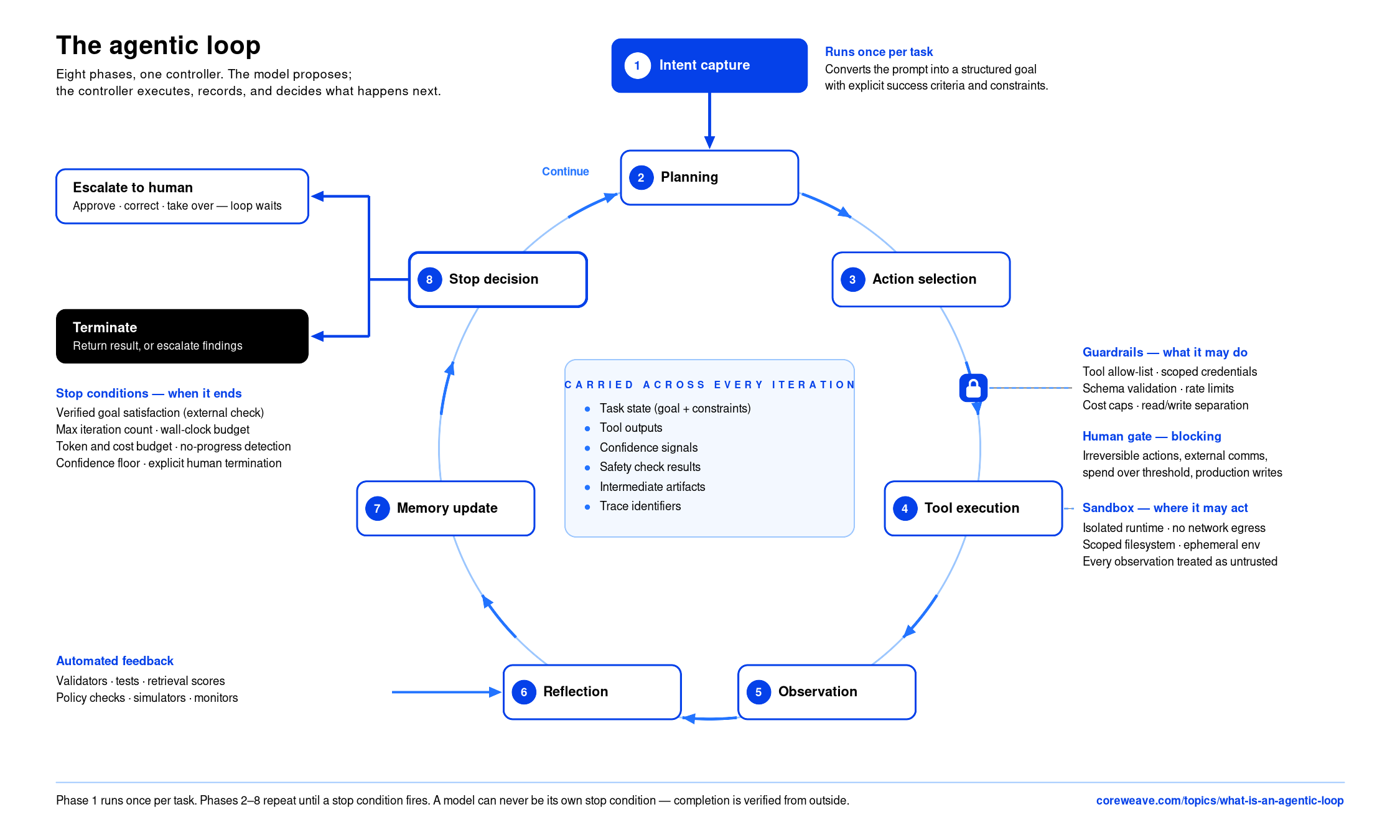
- Intent capture
Convert the user prompt into an explicit, structured task, including success criteria and any constraints. - Planning
Break the goal down into an ordered approach. This might be a single step or a multi-step plan the agent revises as the loop works. - Action selection
Choose the next action and the tool to execute it. - Tool execution
Run the action against a real system—a query, an API call, a file write, a code execution, etc.. - Observation
Log the result, including errors, partial output, and metadata. - Reflection or critique
Evaluate the observation to see if the tool execution made progress toward the goal, contradicted the plan, or failed. - Memory update
Write the outcome back into task state so the next run through the loop reasons from up-to-date facts. - Stop decision
Determine whether to continue, ask for human feedback, or stop the loop.
Phase 1 runs once per task, then phases 2 through 8 repeat.
What data carries between phases
To make debugging and agentic improvement easier, each phase hands off more than just a text response.
Note that explicit chain-of-thought isn’t required. Structured plans, typed tool calls, and observable state allow inspection without delving into private model reasoning—and they’re easier to validate programmatically as well.
An agentic loop example
This agent is investigating why a service is returning high error rates.
- Intent capture
The agent receives "error rate on the checkout service jumped at 14:20." It notes the service, the time, and a success criterion: identify a probable cause for the high error rate, supported by evidence. - Planning
The agent decides that before examining the errors themselves, it should establish what changed at or before 14:20. - Action selection
It selects a deployment history query as its first action, choosing it over log search because a recent change is the cheaper hypothesis to eliminate. - Tool execution
It queries the deployment API for the two hours before 14:20. - Observation
The response shows a configuration change implemented at 14:18, two minutes before the errors. - Reflection
The timing is suggestive but not necessarily causal. The agent notes that it has a candidate, not a conclusion, and that it hasn’t examined the errors yet. - Memory update
The agent writes the deployment timestamp and the open question into task state. - Stop decision
The success criterion hasn’t been met, so the loop continues. The next iteration plans a log query filtered to the error signature, which either connects the errors to the changed configuration or establishes the configuration change wasn’t responsible.
The loop terminates when the agent can credibly tie a specific change to an error signature—or when it exhausts its iteration budget and escalates its findings.
How is agentic AI different from traditional AI and automation?
Traditional AI infers an output based on an input. Traditional automation runs a predefined workflow. Agentic AI selects actions it reasons will meet a goal, observes their effects, and alters its strategy based on what it finds.
Because an agentic system makes its decisions while running, offline model metrics can’t accurately describe its behavior. Thorough evaluation requires runtime instrumentation: permission systems, audit logs, trajectory traces, and feedback routing. Even if your model benchmarks well, your agent may still loop indefinitely or call the wrong tool.
When a deterministic workflow is still better
If the process is known, inputs are stable, and the compliance path is strict, a deterministic workflow is probably the better choice. Deterministic workflows tend to be cheaper, faster, and easier to test and audit.
Where do automated and human feedback enter the loop?
Feedback is what stabilizes the agentic loop. Automated checks can catch fast and well-specified failures, but it takes human judgment to rule on ambiguous, high-impact, or novel cases. Both types of feedback are embedded in specific loop phases rather than bolted-on as an after-the-fact quality check.
Automated feedback
Automated feedback operates at machine speed and scales without adding human headcount. It looks for failures that can be defined precisely and in advance:
- Validators — schema and type checks on tool arguments.
- Tests — executable verification of a produced artifact.
- Retrieval scores — relevance thresholds on retrieved context.
- Policy checks — permission and compliance evaluation.
- Simulators — dry-run execution for actions that are expensive or hard to reverse.
- Monitors — drift, cost, and latency tracking across the full loop.
Human feedback
Human feedback is slower and more expensive than automated feedback, but invaluable for certain decisions. Humans can offer business context, accountability, ethical understanding, and judgment about intent that no metric can fully encode. They’re also, in the end, responsible for the output of the AI agent.
Human feedback typically takes four forms: review of completed work, approval before a gated action, correction of a specific output, and labeling that produces training or evaluation data.
Human-in-the-loop vs. human-on-the-loop
With human-in-the-loop AI, a person approves an action before it executes, whereas with human-on-the-loop, the action proceeds while a person monitors and can step in. The difference is a question of timing and authority. The two are not interchangeable.
Most agentic systems use both: in-the-loop gating on a small set of sensitive actions, on-the-loop sampling for everything else.
What stop conditions prevent an agentic loop from running forever?
Every agentic loop needs at least one stop condition that doesn’t depend on model judgment. A model deciding when to end a loop can stop too early, on a plausible but incomplete answer, or too late, past the point where continued iteration is useful.
Agentic loops generally combine several stop conditions:
- Verified goal satisfaction
An external check (i.e., not from the model) confirms the success criteria are met. - Maximum iteration count
A hard cap on loop passes, independent of any other signal. - Wall-clock budget
A time limit, important when a user is waiting for a result. - Token and cost budget
A per-task budget ceiling that terminates the run when exceeded. - No-progress detection
Termination when the agent repeats states, oscillates between the same two tools, or produces no new information across multiple iterations. - Confidence floor
Handoff to a human when the agent's own confidence drops below a certain threshold. - Explicit human termination
An operator can stop any run.
Why an AI model can’t be its own stop condition
The most common failure in early agentic systems was self-reported completion. A model would ask itself whether it had met the success criteria and, seeing a plausible-looking answer that looked correct on the surface, say yes. Rewarding plausibility rather than accuracy creates agents that confidently offer up wrong answers.
Completion and accuracy must be verified from outside the model: a passed test, a validated schema, a query that returns the expected shape, or a thumbs-up from a human. The model may think it’s done, but something else has to agree.
What guardrails and sandboxing does an agentic loop need?
An agentic loop needs three distinct kinds of boundaries: stop conditions that tell it when to end, guardrails that control what it can do, and sandboxing that tells it where it may act. Without all three, it will run until something breaks or it takes unauthorized action.
Guardrails — what the agent may do
Guardrails constrain the agent’s possible actions:
- Tool allow-lists — the agent can only call specific tools, not everything the API exposes.
- Scoped, short-lived credentials — permissions sized to the task that expire with it.
- Read/write separation — broad read access, narrow write access.
- Irreversible-action gating — deletions, payments, external communications, and production changes require approval (often from a human).
- Rate limits — caps on calls per tool per run, which also delineate budget.
- Schema validation on tool arguments — malformed or hallucinated arguments are rejected.
- Per-task cost caps — hard spend limits enforced by the controller.
Sandboxing — where the agent may do it
Sandboxing controls the blast radius when a guardrail is bypassed or an action produces unexpected behavior:
- Isolated execution environments for any code or shell action.
- Restricted network egress so a compromised run can’t reach external hosts.
- Filesystem scoping limited to the directories relevant to the task.
- Ephemeral environments created in the run and destroyed afterwards.
- Validated tool output that assumes any observation may be adversarial.
Unfortunately, adversarial input isn’t hypothetical. Agentic systems usually ingest prompt injection through retrieved content: a web page, a document, a code comment, a support ticket. The agent fetches the content and the prompt injection enters the context as instructions. Sandboxing limits what prompt injection can accomplish.
Human checkpoints—when the agent hits a gate
Gating every step produces alert fatigue and destroys the latency benefits. “I could have just done this myself,” the human user thinks. A more efficient system gates selectively, at points where being wrong is expensive:
- Irreversible actions
- External communication
- Spend that exceeds threshold
- Low-confidence situations
- Actions that touch regulated data or production systems
Everywhere else, a review of samples after-the-fact usually gives adequate coverage at a much lower cost.
Graduated autonomy
Autonomy shouldn’t be granted globally. Instead, agentic systems should earn autonomy by proving their success at a given action type. Start by gating heavily. Collect loop data. Lower gates on actions where the data shows the agent performs reliably, and keep the rest.
What are the trade-offs of using an agentic loop?
Don’t assume an agentic loop is automatically better than a single model call or a deterministic workflow. AI agents balance latency, cost, and easy testability with multi-step reasoning, adaptability, and recovery from partial failure.
Is your loop worth building? Consider four trade-offs:
- Accuracy vs. latency. Planning, validation, and human review improve accuracy but add time. A loop with three validators and an approval gate might be very accurate but completely unusable in a production setting.
- Cost vs. throughput. Every loop iteration is a model call, so per-task cost goes up while throughput goes down. For AI agents, cost per resolved task is the meaningful metric.
- Flexibility vs. determinism. Runtime action selection can tolerate ambiguity that fixed workflows can’t, but the same input may produce different outcomes. Agentic loops give up repeatability to get adaptability.
- Safety vs. autonomy. Broad tool access makes agents useful, but it can also make them risky. The best way to reduce risk is to narrow what an agent can touch and how.
What are the most common agentic loop failure modes?
The most common agentic loop failures are control failures, not model failures in isolation. Agents might loop without any progress, trust poisoned observations, or obscure responsibility because the harness didn’t record state, decisions, and interventions.
Control failures
Infinite retries, oscillating between two tools, stopping prematurely, and judging success on plausibility rather than accuracy all describe the same underlying problem: a loop that can’t determine whether or not it’s making progress. Mitigate this with stop conditions.
Model and tool failures
Schema validation and sandboxing can catch hallucinated tool arguments and prompt injection through tool outputs, but other failures slip through. Two that can only surface through comparing loop trajectories are stale retrieval context, where outdated information is treated as current, and nondeterministic responses, where identical state produces different actions across runs.
Human-in-the-loop failures
Humans aren’t infallible, and they sometimes introduce their own failure modes:
- Reviewer inconsistency — different reviewers apply different standards to the same case.
- Alert fatigue — excessive gating trains reviewers to approve without reading.
- Bottlenecks — throughput matches the review team's capacity, not the system's.
- Unclear accountability — nobody can say who really owned the decision, agent or approver.
- Uncaptured feedback — corrections stay in a chat thread and never become an eval case.
Telling reviewers to try harder doesn’t fix any of these problems. A smart team mitigates them by gating fewer actions, calibrating reviewers against shared cases, capping escalations, thoroughly logging decisions, and giving corrections a defined route into their eval set.
How do you evaluate an agentic loop?
Evaluating an agentic loop means evaluating the entire trajectory, not just the final response. A correct answer that called six unnecessary tools and performed an unjustified production write doesn’t get a passing grade.
What to measure
What are agentic loops used for?
Agentic loops are a good choice for tasks that benefit from iterative investigation and produce evidence that can be observed. If the useful work involves gathering context, testing hypotheses, and narrowing down possibilities, an agentic loop structure may be a good choice.
Good fits for agentic loops include:
- Security triage
An agent enriches an alert across multiple sources before a human makes a decision on containment. - Incident response
An agent correlates deployments, metrics, and logs to isolate a probable cause. - Coding agents
An agent reads code, makes changes, runs tests, and iterates on failures. - Customer support escalation
An agent gathers account context and history before routing the customer request.
For all these use cases, the underlying agentic AI loop structure is the same: the agent gathers context and proposes approaches, while humans maintain authority over decisions that are expensive or irreversible.
When should you not use an agentic loop?
Don’t use an agentic loop just because the task is complex—use one because the task is ambiguous. If the process is the same from task to task and the inputs are nicely structured, a deterministic workflow will be cheaper, faster, easier to test, and more simple to control.
Signs you shouldn’t use an agentic loop:
- Strict latency budgets — multi-iteration loops are slower than deterministic workflows.
- Irreversible actions without gating — if you can’t gate it, do not automate it agentically.
- Unclear ownership — if nobody owns the agent's decisions, nobody is answerable for its failures.
- Weak observability — an agent you can’t trace is an agent you can’t debug, evaluate, or improve.
- Broad, unsafe tool access — giving agents unscoped production credentials is a liability regardless of how good your underlying model is.
Human review doesn’t save a poorly scoped agent. It adds cost and delay, and still fails if the escalation criteria are vague. It’s better to start with a constrained workflow and add agentic steps where ambiguity or iterative search can measurably improve outcomes.

