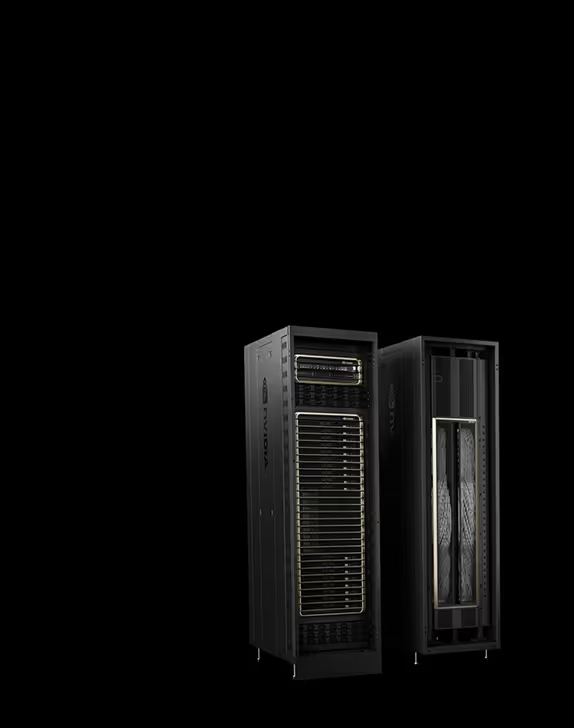
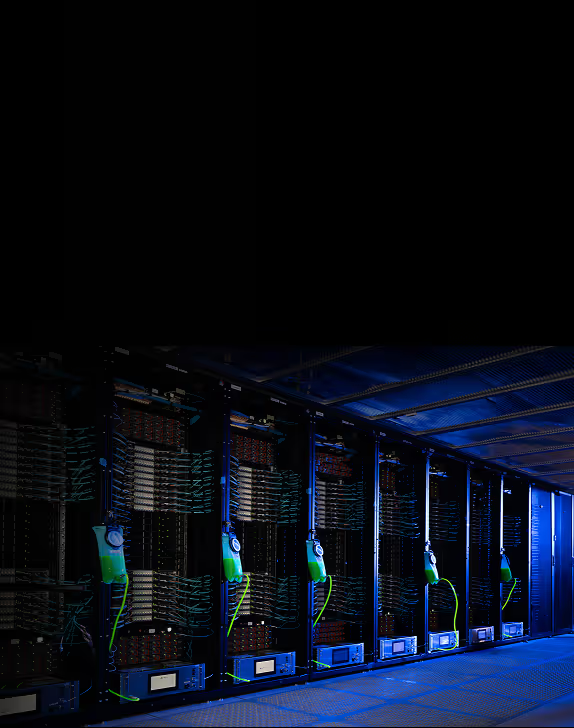
Bare metal, within the context of AI infrastructure, refers to running workloads directly on single-tenant physical hardware (CPU, GPU, memory, storage, and network) without a hypervisor. With no virtualization layer, your operating system and application have direct access to the hardware, eliminating the overhead and latency that come with multi-tenant “noisy-neighbor” contention and a hypervisor.
The rise of bare metal in AI infrastructure comes at a pivotal moment. As models grow in size and latency requirements tighten, the industry leverages direct-to-hardware architectures to extract maximum performance, enable low-level tuning, and meet increasingly strict data-sovereignty and compliance requirements.
In the sections that follow, we’ll compare bare metal to virtualized infrastructure, outline its key benefits for AI and HPC workloads, and show how teams are layering serverless orchestration on top of bare-metal clusters to achieve elasticity—without the VM tax.
Bare-metal GPU infrastructure
A bare-metal server is a single-tenant physical machine (CPU, RAM, storage, network) provisioned directly to one customer with no virtualization layer. There are other forms of virtualization, such as GPU virtualization, but those are less common in the industry. When describing bare metal vs. virtualization, most companies refer to the server or the larger system.
Bare-metal GPU infrastructure is built to deliver maximum performance by minimizing overhead from abstraction layers. Unlike traditional computing environments, where workloads often run inside virtual machines on top of a hypervisor, bare-metal GPUs provide direct access to dedicated hardware. There’s no shared tenancy, no intermediate OS layers, and no virtualization overhead—just a straight path from workload to hardware.
Bare-metal GPU deployments typically follow this layered structure:
- Physical server: a single-tenant machine equipped with CPUs, memory, local NVMe storage, and one or more high-performance GPUs (e.g., NVIDIA H100, Blackwell GB200)
- GPU fabric/interconnect: high-bandwidth interconnects like NVLink, NVSwitch, or InfiniBand enable multi-GPU parallelism and distributed training performance
- Network layer: servers are connected via high-throughput, low-latency networks (often >100 Gbps) that support RDMA, peer-to-peer traffic, and east-west scalability
- Container orchestration (optional): orchestration tools manage and elastically schedule workloads across physical nodes
- Workload layer: AI models, inference APIs, and HPC applications are deployed as containers or jobs that run directly on the metal—no hypervisor, no virtual machine (VM)
This architecture gives users control over low-level system settings without any virtualization layer in the way. It also enables fast provisioning through pre-configured clusters and containerized environments without the performance tradeoffs of traditional, virtualized platforms.

Bare metal vs. virtualization
The traditional way to deploy cloud workloads has relied on virtualization: using hypervisors to abstract and share physical hardware across multiple tenants. This approach provides flexibility and fast provisioning, but also introduces performance overhead and limits the user’s ability to access or tune low-level resources.
Compared to VMs, bare metal eliminates the virtualization layer and provisions workloads directly onto single-tenant physical servers. That means no hypervisor, no shared CPU/memory contention, and full control over how resources are allocated, scheduled, and tuned.
How workloads run in virtualized vs. bare-metal environments
While virtualization offers flexibility, bare metal offers predictability and performance. For teams running large-scale AI or latency-critical workloads, that tradeoff increasingly favors direct-to-hardware deployments.

Benefits of bare metal servers
Bare metal isn’t just a hardware choice. It’s a performance strategy. By running directly on single-tenant physical infrastructure, teams building and deploying large-scale AI, HPC, and real-time systems can unlock a level of performance, control, and efficiency that virtualized environments simply can’t offer.
Here’s why performance-driven teams increasingly prefer bare-metal deployments:
- Security and compliance: physical isolation enhances data privacy and supports strict regulatory requirements like HIPAA, PCI-DSS, and FedRAMP
- Raw compute performance: applications fully utilize CPU, GPU, and memory resources without a hypervisor, enabling faster training, lower latency, and higher throughput per dollar
- Deterministic latency: dedicated resources eliminate noisy neighbors, ensuring predictable performance for real-time, latency-sensitive workloads
- Full hardware control: direct access to underlying infrastructure enables deeper system-level optimization for AI and HPC workloads
- High GPU density & interconnect flexibility: tightly coupled multi-GPU systems with NVLink or InfiniBand support high-performance distributed training and inference
- No idle VM tax: eliminates hypervisor overhead and reduces wasted capacity, improving efficiency and cost utilization
- Improved reliability and visibility: removing the hypervisor reduces potential points of failure and makes it easier to monitor, diagnose, and troubleshoot system performance
From low-latency LLM serving to large-scale computer vision training to tightly tuned physics simulations, bare metal provides the uncompromised performance foundation that modern workloads demand.
Challenges of bare metal servers
While bare metal offers strong performance and control, it also introduces additional operational considerations, especially for teams accustomed to fully abstracted cloud environments.
- Requires infrastructure ownership: teams take on more responsibility for managing and operating underlying systems compared to fully abstracted environments
- Scaling requires coordination: capacity planning and workload placement become more important, particularly for large GPU clusters
- Greater control increases complexity: deeper access to hardware and system configuration introduces more decisions around optimization and management
Many of these challenges are mitigated by platforms that provide built-in orchestration, observability, and cluster management, making it easier to deploy, monitor, and scale bare-metal environments without added operational overhead.
Best uses cases for bare metal
Bare-metal GPU infrastructure is designed for performance at scale, making it ideal for demanding AI, HPC, and latency-sensitive workloads. With direct access to physical hardware, teams can extract more throughput per dollar, minimize latency, and fine-tune system behavior to meet the specific needs of their models and pipelines.
Here’s how teams are putting bare-metal GPUs to work today:
AI model training & fine-tuning
Organizations training large foundation models or running multi-GPU fine-tuning jobs often deploy clusters of bare-metal GPU nodes, interconnected with high-bandwidth fabrics like NVLink or InfiniBand. These clusters support distributed training frameworks (like PyTorch, DeepSpeed, or TensorFlow) and enable low-level control over job scheduling, memory layout, and GPU topology that result in faster convergence and more predictable performance.
Large-scale inference
Serving large models, especially LLMs and diffusion models, requires tight latency control and high throughput. Bare-metal environments help teams deploy inference workloads as containerized APIs or batch jobs that launch directly onto GPU nodes, without virtualization bottlenecks. This direct scheduling enables faster cold starts, efficient autoscaling, and consistent tail-latency performance.
Scientific computing & simulation
HPC applications like molecular dynamics, fluid simulation, and weather modeling benefit from bare metal’s consistent I/O performance and low-latency networking. Many of these applications rely on MPI-based communication across nodes, which performs best on systems with RDMA-enabled interconnects and minimal OS abstraction.
Real-time workloads
From financial trading to multiplayer gaming infrastructure, real-time systems rely on predictable, low-jitter compute. Bare-metal deployments give teams the ability to pin workloads to specific CPUs, optimize NIC behavior, and remove sources of unpredictable latency, ensuring real-time SLAs are met.
Compliance-sensitive environments
For workloads that handle protected health data, financial transactions, or regulated government workloads, bare metal offers a higher degree of tenant isolation and auditability than shared VM infrastructure. With dedicated physical machines, teams can better control access boundaries and meet compliance standards like HIPAA, PCI-DSS, and FedRAMP.